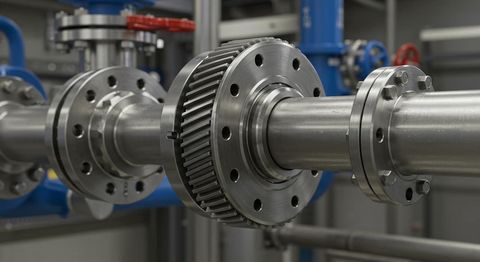
Industrial couplings play an important role in these systems by joining two shafts and transmitting torque while accommodating certain types of movement or alignment differences.
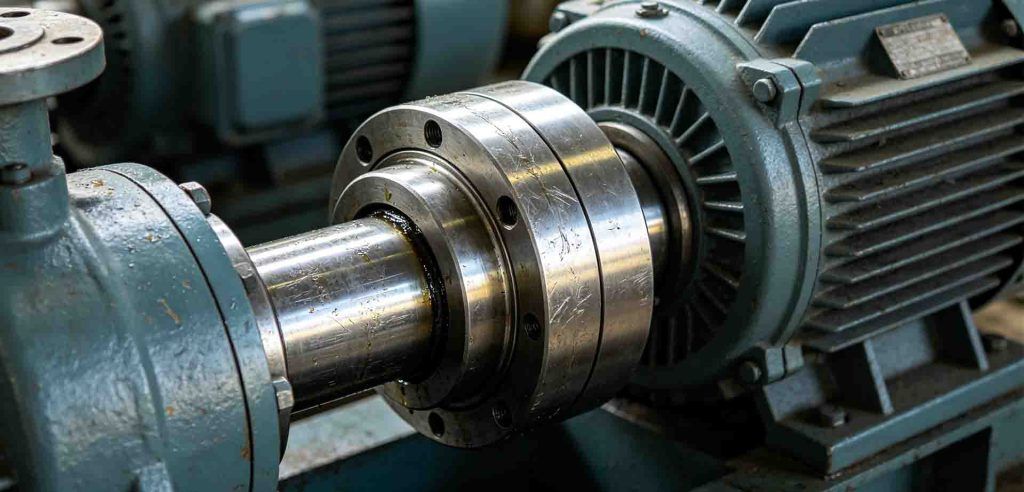
Choosing a suitable coupling requires more than matching shaft dimensions. Engineers and maintenance teams must consider operating speed, transmitted torque, vibration, temperature, environmental conditions, and the amount of misalignment present. The wrong choice can contribute to excessive wear, vibration, equipment damage, or unexpected downtime.
This guide explains the main types of Industrial Couplings, their common applications, and the factors that influence selection and maintenance.
What Are Industrial Couplings?
Industrial couplings are mechanical components used to connect two rotating shafts. Their primary function is to transfer rotational power from a driving machine, such as an electric motor, to a driven machine, such as a pump or gearbox.
Some couplings create a rigid connection, while others include flexible elements that accommodate limited misalignment, absorb shock, or reduce vibration. Certain designs also allow easier assembly and disassembly during equipment maintenance.
Couplings are used across manufacturing, agriculture, energy production, material handling, water treatment, and many other industrial environments. Their design depends on the equipment, load characteristics, operating conditions, and required level of flexibility.
A coupling should not be expected to correct serious shaft misalignment. Proper installation and alignment remain important, even when a flexible design is used.
Common Types of Industrial Couplings
1. Rigid Couplings
Rigid couplings connect two shafts with very little allowance for relative movement. They are suitable when the shafts can be aligned accurately and the equipment does not require substantial flexibility at the connection.
Common designs include sleeve, clamp, and flange couplings. Sleeve couplings join shafts through a connecting sleeve, while flange couplings use bolted flanges to create a firm connection.
Rigid couplings are used in machinery where accurate alignment can be maintained. However, they can transfer alignment errors directly to connected components, increasing stress on bearings and shafts if installation is inaccurate.
2. Jaw Couplings
Jaw couplings generally consist of two metal hubs with interlocking jaws and an elastomeric element between them. The flexible element helps transmit torque while accommodating limited misalignment and reducing some vibration.
These couplings are commonly found in pumps, small compressors, conveyors, and general industrial drives. The elastomeric element may be made from different materials, each with its own temperature range, stiffness, and resistance to chemicals.
When selecting a jaw coupling, users should check the torque rating, rotational speed, operating temperature, and compatibility of the insert with the surrounding environment.
3. Gear Couplings
Gear couplings transmit torque through meshing gear teeth between connected hubs and sleeves. Their compact design can support high torque loads in many industrial applications.
They are used in equipment such as large drives, rolling mills, and heavy machinery. Depending on the design, they can accommodate limited angular, parallel, or axial movement.
Gear couplings generally require suitable lubrication and periodic inspection. Poor lubrication, contamination, or worn gear teeth can increase friction and shorten operating life.
4. Grid Couplings
Grid couplings use a flexible metal grid fitted between specially shaped hub teeth. The grid transmits torque while allowing limited flexibility under changing loads.
These couplings are used in equipment such as conveyors, crushers, pumps, and industrial drives where shock loads or torque fluctuations may occur. Their flexibility can help reduce the impact of sudden load changes.
Inspection should focus on grid condition, lubrication, hub wear, and signs of overheating. Damaged components should be replaced according to the manufacturer's maintenance guidance.
5. Disc Couplings
Disc couplings use thin metallic discs or disc packs to transmit torque. Their design allows certain types of misalignment through controlled flexing of the discs.
They are often used in high-speed machinery, compressors, turbines, and precision equipment. Many designs operate without routine lubrication at the flexible element, although the complete assembly still requires inspection.
Disc couplings should be selected carefully because excessive misalignment or incorrect installation can place additional stress on the discs and connected shafts.
6. Fluid Couplings
Fluid couplings transfer rotational energy through a fluid rather than through a direct mechanical connection between driving and driven elements. They typically contain an impeller and runner inside a housing filled with an appropriate fluid.
These devices are used in some conveyors, industrial drives, and heavy equipment where gradual acceleration can help reduce mechanical shock. They are different from direct mechanical shaft couplings and have specific operating requirements related to fluid condition, heat, and load.
Applications Across Industries
Industrial Couplings support a wide range of mechanical systems.
Manufacturing: Connect motors to gearboxes, conveyors, mixers, and production machinery.
Water management: Link electric motors with pumps used to move water or other compatible liquids.
Agriculture: Transfer rotational power in selected irrigation systems and agricultural equipment.
Energy production: Connect rotating components in certain power-generation and auxiliary systems.
Mining and material handling: Support drives used in conveyors, crushers, and other heavy equipment.
Chemical processing: Connect machinery used in industrial processes, with material selection based on chemical exposure and operating conditions.
The application determines which coupling characteristics matter most. A precision machine operating at high speed may need different properties from a conveyor exposed to shock loads and dust.
Key Factors When Selecting an Industrial Coupling
Torque and Load Requirements
Torque is the rotational force transmitted through a shaft. A coupling must be rated for the torque generated by the connected equipment, including expected starting loads and fluctuations during operation.
Engineers should consider the motor's power, rotational speed, driven equipment, and possible overload conditions. A coupling selected only for normal running torque may not be suitable when frequent starts, stops, or sudden load changes occur.
Shaft Size and Connection Design
Shaft diameter, keyways, mounting arrangements, and available installation space influence coupling compatibility. The hub bore and fastening method must match the connected shafts.
Accurate measurements help avoid excessive clearance, incorrect fitting, or unnecessary stress. Drawings and manufacturer specifications should be checked before installation.
Misalignment and Flexibility
Shafts may experience angular, parallel, or axial misalignment. Angular misalignment occurs when shaft centerlines meet at an angle, while parallel misalignment occurs when they are offset. Axial movement refers to movement along the shaft's length.
Different coupling types accommodate different amounts of movement. The permitted limits must be checked in the technical documentation. Flexible couplings should not be used as a substitute for correcting significant alignment problems.
Speed and Operating Environment
Rotational speed affects the mechanical stresses acting on a coupling. High-speed applications may require careful balancing and specific design features.
Temperature, moisture, dust, chemicals, and corrosive conditions also influence material selection. Elastomeric components may become harder or softer under unsuitable conditions, while metallic parts can deteriorate when exposed to incompatible environments.
Maintenance Requirements
Some couplings need regular lubrication or replacement of flexible elements, while others require less routine intervention. Maintenance teams should consider inspection access, component availability, and the time needed to replace worn parts.
A design that fits the operating environment and maintenance schedule can help reduce interruptions and simplify equipment management.
Installation and Maintenance Practices
Correct installation is essential for reliable coupling operation. Before assembly, technicians should inspect shaft surfaces, hubs, keys, fasteners, and flexible elements for damage or contamination.
Shaft alignment should be measured using an appropriate method, such as a laser alignment tool or dial indicators. Fasteners should be tightened according to the specified procedure, and lubrication should be applied where required.
During operation, unusual vibration, noise, heat, or visible wear may indicate a developing problem. Maintenance teams should investigate these signs rather than waiting for the coupling to fail.
Equipment must be isolated and secured before inspection or repair. Rotating machinery presents serious hazards, so maintenance should follow established safety procedures and manufacturer instructions.
Conclusion
Industrial Couplings connect rotating shafts and transfer power across a wide range of machinery. Rigid, jaw, gear, grid, disc, and fluid designs each have different operating characteristics and applications.
Selecting a suitable coupling involves evaluating torque, shaft dimensions, misalignment, speed, environmental conditions, and maintenance needs. Correct alignment, regular inspection, and adherence to technical specifications help support reliable operation and reduce avoidable equipment problems.